
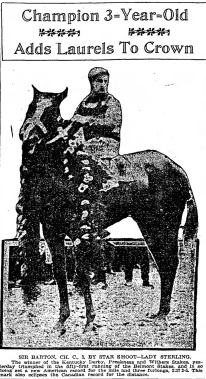
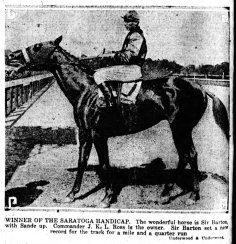
 In 1919, a colt named Sir Barton dazzled everyone with wins in the Kentucky Derby, the Preakness Stakes, and the Belmont Stakes. This trio of victories changed the sport of horse racing in the United States forever, evolving into the Triple Crown, one of horse racing’s most elite accomplishments.
In 2019, horse racing will celebrate the 100th anniversary of his domination of the American classics, duplicated only twelve times since. From Gallant Fox to Citation, Secretariat to Justify, we will celebrate the pioneering horse whose accomplishment a century ago helped to make the horses that followed him household names.
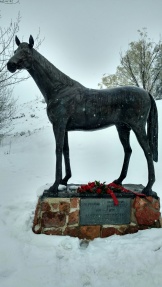
In May 2019, Sir Barton’s story comes to a bookseller near you, told in full for the first time. From his royal pedigree to his unusual final resting place, learn about America’s first Triple Crown winner and his human connections, from his ambitious owner to his controversial trainer to the Hall of Fame jockeys that guided him to victory after victory. Follow Sir Barton and Man o’ War through their historic 1920 seasons, culminating in a match race in an unexpected place.
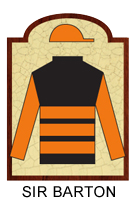 Here on the Sir Barton Project, I will count down to the release of Sir Barton and the Making of the Triple Crown with a weekly series of blog posts. Each month, I will profile a book on horse racing and its author, covering a variety of the sport’s iconic personalities. You will find more on Sir Barton and his era, posts that preview what you will find in the book. As a long-time horse racing fan, I will also share my own memories of the sport I love. As we await the 2019 Triple Crown season, please join me here each week in this run-up to the 100th anniversary of Sir Barton’s accomplishment.
Sir Barton and the Making of the Triple Crown will be brought to you in May 2019 from the University Press of Kentucky.
 One hundred and two years ago, Lady Sterling dropped to the straw of the foaling stall she had been laboring in and, about two in the morning, delivered a beautiful chestnut colt, one of about a hundred born at Hamburg Place that year. The colt had a wide blaze that started high on his forehead, just under his ears, and cascaded down his lovely face, veering off over his left nostril. Half-brother to Sir Martin, the best two-year-old of 1908, the colt that would become Sir Barton was the son of Star Shoot, a descendant of an English Triple Crown winner, and Lady Sterling, a daughter of Hanover, 1887 Belmont Stakes winner. He was royally bred and, as he grew, his potential glowed.
 The Sir Barton Project