Anticlimactic

America’s latest Triple Crown winner, American Pharoah, ended his racing career with a bang two years ago, winning the Breeder’s Cup Classic in 2:00.07, easily a track record time. California Chrome, another fan favorite and winner of two-thirds of the Triple Crown, went to Gulfstream Park and faced Arrogate again; Chrome finished far back of the big grey colt that bested him in the Breeder’s Cup Classic mere weeks prior. Unlike Pharoah, Chrome’s last race was not a fitting end to the stellar career that included wins in the Dubai World Cup, the Kentucky Derby, the Preakness, and more.

When top horses end their careers with clunkers, hindsight says that the connections should have stopped when they were ahead. How can they allow this horse to go out and tarnish their careers with lackluster starts? The irony is, that any owner or trainer or jockey cannot know that this last start should have been the last start. We’d all like our favorites to go out on top, but rarely do they get to do that.

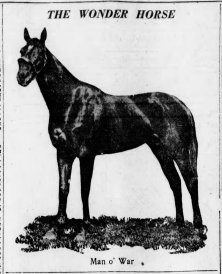
Man o’ War did, exiting the match race in October 1920 with his stellar reputation intact. The film of his long, twenty-eight-foot stride played across movie houses across the country. Sam Riddle showed him off both on film and in person before sending his prized immortal horse off to stud, satisfied that they had accomplished all that they could with their incomparable colt. The horse that finished second to him in that very same race, Sir Barton, did not fare as well.

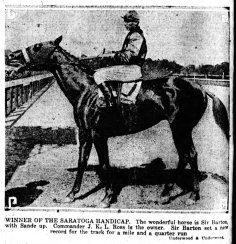
Many times as I have researched Sir Barton and his career, I have seen writers say that the match race was the last race for the first Triple Crown winner as it was for his rival. It was not, however; Sir Barton would start three more times before year’s end. The first was ninety-seven years ago, in the Laurel Handicap.

Carrying 125 pounds for this race, Sir Barton strode out onto the Laurel track for this one-mile race. He faced a field of five others, all horses he had seen in one capacity or another, usually when he beat them to the wire. The Laurel Handicap should have been a cakewalk for him, especially given the caliber of performance he had turned in when he won the Merchants and Citizens Handicap in late August. Instead, under a new-to-him jockey, Jack O’Brien, Sir Barton showed little of what had made him so great mere weeks earlier. After a lackluster warm-up, Sir Barton broke well enough, settling into third behind the front-runners. When it came time to make his move and challenge for the lead, O’Brien could not get his mount to respond. They barely held off a surging Sennings Park to finish third in a race with a brisk, but not sizzling pace.

Sir Barton would start two more times, both at Pimlico; he did not win either start, but he was in the money for all of them. The only horse seen fit to challenge Man o’ War was game enough to stay in it, but he didn’t seem to have enough left in his tank — or heart — to be the stellar racehorse that he had been so many times before. Following him throughout this was the towering shadow of his rival, always coloring the prose whenever his name came up in the papers of the day.

Like Chrome and so many others, those last starts did fit the career of the horse that paved the way for Secretariat and American Pharoah, a fitting testament to the uncertainty that is the sport of racing.
“The Race of the Age”

Today marks the ninety-seventh anniversary of the 1920 Kenilworth Gold Cup, better known as ‘The Race of the Century’ between Man o’ War and Sir Barton. The mile-and-a-quarter confrontation was meant to be the ultimate test of both horses, a chance for two record-breakers to thrill the crowd with the speed that their reputations were built on. Ringing the hard-packed dirt oval that October day at Kenilworth Park were fourteen cameras, each stationed at a vantage point that would allow them to film the two combatants. Those cameras created the first known complete horse race on film, billed as “The Race of the Ages.”

Evening_Public_Ledger_Thu__Aug_5__1920_.jpg
Sir Barton

The two-reel film from the Educational Film Exchanges showed some of the preparations both stables undertook in order to get their horses to the barrier for the match race as well as the race from both ground level and high above the track. The filmmakers took great care to capture Man o’ War’s stride in slow motion in order to show audiences across the country what made the colt so dominant in his scant two years on the race course. Lost in all of this seemed to be his competitor, Sir Barton, himself a champion and a record-breaker, but certainly not the star of the show. Newspapers recorded that Samuel Riddle, Man o’ War’s owner, held a dinner to show off the film that featured his dominant and legendary stallion; when, how, and if Commander Ross viewed the film himself, was not information that any reader was privy to in 1920.

Advertisements for showings of “The Race of the Age” ran in newspapers across the country well into 1921 as articles giving Man o’ War’s every move chronicled his transition into retirement while controversy followed Sir Barton into the new year. Soon, the first Triple Crown winner’s name seemed to only appear alongside that of his ever-dominant rival, Sir Barton’s defeat at the heels of Man o’ War running on movie screens everywhere over and over again. The diminishing of the reputation of the first horse to complete the biggest accomplishment in racing accelerated with each advertisement. How easy it is to change public perception with something small like an ad, like a death by a thousand small cuts rather than great swinging lashes.

The two reels of “The Race of the Age” seem to be lost to history, a victim of the time that has elapsed between our era and theirs. Searches through a number of archives across the United States, including the National Archives, has produced no known copies of the film. Clips appear on YouTube, but the entirety of the race, as well as those precious images of both horses getting ready to run at Kenilworth, elude this researcher at present. I did find this short clip for you to enjoy as you think back to “The Race of the Age,” on this day ninety-seven years ago.

Sir Barton on Bourbons & Barns

Griffin Coop was kind enough to do a Q&A with me about Sir Barton as we look forward to Always Dreaming’s attempt to win the Preakness Stakes after his win in the Kentucky Derby this past Saturday.

Please visit Bourbon & Barns for the Q & A and more.


Happy Birthday, Man o’ War!

The_Brooklyn_Daily_Eagle_Thu__Aug_19__1920_Last year, I wrote a blog post (or two) in celebration of the 100th birthday of Sir Barton, the namesake of this particular website and the project I’ve spent most of the last four years writing. I live daily with Sir Barton and his connections; I’ve likely done more research on that horse, his owners, his trainer, his breeder, and others than anyone else ever has. Wherever Sir Barton went in his life, I follow in whatever way I can given the time elapsed between us. Inevitably, though, our journey intertwines with another chestnut colt, so ubiquitous in reputation that even people who may not know a thing about thoroughbred racing have heard of this horse.

Man o’ War.

Continue reading “Happy Birthday, Man o’ War!”

Head to Head

It’s not a match race, really. When a race has twelve horses slated to start, each paying $1,000,000 for the privilege of running, the Pegasus World Cup Invitational at Gulfstream Park is a true horse race. Twelve starters, many possible outcomes.

Right?

The coverage of the Pegasus, part of a slate of seven stakes races on Saturday, January 28th, pays lip service to the other ten starters, but really it all seems to come down to two horses: Arrogate and California Chrome. Arrogate, the four-year-old youngster, recently voted the world’s best racehorse by Longines, conqueror of the last year’s Travers Stakes and Breeder’s Cup Classic. California Chrome, six years old, on the verge of retirement and stud life, twice Horse of the Year, conquered by the upstart Arrogate both in the Classic and in the voting for world’s best racehorse.

The gate might hold twelve, but the world only sees two. Only two names matter.


Arrogate vs. California Chrome. Speedy wonder with only one loss in his racing career versus the veteran who nearly won a Triple Crown and beat all comers in 2016 except this newly minted rival. With one voted the best in the world, barely edging out the other, the question of supremacy becomes paramount.

Where have we seen this before?

Continue reading “Head to Head”

Making and Breaking Reputations


On October 12, 1920, about 3.37 pm, two horses stood at the barrier on Kenilworth Park’s dirt oval. The largest crowd ever to grace the stands watched as the two took to the track, one clad in Ross orange and black and the other in the yellow and black of Samuel Riddle, each known as the best of his class. As they lined up by the starter, one towering over the other, their riders took their positions, gripping the leather reins and waiting for this particular job to begin.

The match race itself had come together rather quickly, a response to the drumbeat of desire that threatened to drown out everything else in thoroughbred racing that fall. Man O’War had conquered all comers to that point, save for a slight blip on the map named Upset, but his owner’s caution had left one question still to be answered: how would Big Red fare amongst older horses? When Willis Sharpe Kilmer dropped his Exterminator out of the mix, Sir Barton became the symbol of the best that the older class had to offer: record setter under heavy weights, Triple Crown winner, the star of the Ross Stable. For the champion, though, the one who had done what Man O’War hadn’t, 1920 had been a hard campaign, with eight starts, three in August alone, after thirteen in 1919. Sure, Man O’War had had ten starts in 1920, but he didn’t have the shelly hooves that plagued Sir Barton. The track at Kenilworth was hard and fast, thanks to Abe Orpen’s hope for a speed duel. For Sir Barton, the solid surface and the residual soreness of a long campaign brought on lingering questions about soundness, but no one in the Ross camp was going to give their hand away. Kenilworth, though, had taken on a dour air as a result. As J.K.M. Ross laments in Boots and Saddles, this was “a battleground for greatness and a breeding ground for disappointment and distortion” (207).

With his obvious advantages in height and muscle, it was clear how tremendous Man O’War was next to Sir Barton. While the Triple Crown winner was not the largest horse, he clearly showed why he had been so good on the track versus so many of the era’s best horses. Standing there at the barrier, though, Sir Barton looked like a common plater next to Man O’War. The race was nearly a foregone conclusion, but Ross’s sense of sportsmanship wouldn’t allow him to withdraw from the contest. In the end, Man O’War’s conquering of his competition only intensified the ascendency of his star. For Sir Barton, though, it might have been the contributing factor to his slow fade into near obscurity.

Ninety-six years ago today, the Kenilworth Gold Cup was the match race that turned out to be no match at all. For Man O’War, the race resulted drinking champagne from the race’s gold trophy and retiring to stud to make an indelible and lasting mark on the pedigree of all thoroughbreds racing today. For Sir Barton, it was the end. He ran two more times, but his soundness and heart weren’t up to the task. He went quietly to stud and then, because of death and circumstance, to the Wild West, resting for all time in rural Wyoming.

But he left his mark loudly even if he went off quietly into the night. It’s in the walls of noise at Churchill Downs and Pimlico and Belmont in the spring. It’s in the vaunted places of horses like Citation, Secretariat, Affirmed, and now American Pharoah in the pantheon of thoroughbred racing. He may not have been a behemoth on the track, but his achievement on those spring days in 1919 has become the yardstick by which we measure all horses to this day.

Not even Big Red wears his crown.

https://www.youtube.com/watch?v=yC86Jm5oiMc