Winless Wonders in the Kentucky Derby

2017_Kentucky_Derby_logoWith this year’s edition of the Kentucky Derby coming up fast, let’s look at something that a horse rarely can be entering Derby week: a maiden. With the Derby now requiring a certain number of points in order to make it into the gate, a horse will need to finish in the money in more than one race or finish second in the right races to join the cavalry charge of horses in Louisville. Before the points system became reality, a horse could come into the Derby as a real maiden; nine have done it since 1937. Their chances of winning, though, might not be as good since they may not have the experience or the talent to be the one in front at the wire at Churchill Downs.

These three maidens defied the odds and did just that, making the Run for the Roses their own.

Buchanan (1884)

buchananIn the last part of the 19th century, African-American jockey Isaac Burns Murphy won three Derbies (1884, 1890, 1891), his first on a firebrand chestnut named Buchanan.

Buchanan had not won a race prior to his start in the 1884 Kentucky Derby and was, from contemporary accounts, a difficult horse to ride. Murphy was one of the best jockeys of the day, though, and managed Buchanan well enough for the colt to break his maiden in the Run for the Roses. Buchanan went on to a record of 35: 8-14-10, winning the Ripple Stakes and the Clark Handicap before retiring at the age of three.

Buchanan stood stud at Senorita Stock Farm in Lexington, KY, the site of the present -day Kentucky Horse Park. He didn’t make much of an impression at stud, siring only three stakes winners, and died in either 1894 or 1897 (contemporary accounts differ) of an inflammation of the bowels.

Sir Barton (1919)

SBDerbyWinnerSir Barton made his last start of 1918 in the Futurity at Belmont in September; he was due to make additional starts in his two-year-old season before an illness put him out of commission for the remainder of the year. Trainer H.G. Bedwell declined to start the colt in any races in the first part of 1919, though stablemate and fellow Kentucky Derby starter Billy Kelly did have three starts prior to Derby Day. Sir Barton prepared instead through a series of workouts with other horses in the Ross Stable, demonstrating just how good the three-year-old son of Star Shoot* was.

Saturday, May 10th dawned rainy and wet, with the Churchill Downs oval heavy from rain. Twelve went to the post and one left the barrier flying: Sir Barton. He led at every pole and never surrendered, not even to Billy Kelly, for whom he was supposedly there to clear the way. Sir Barton went on to follow up that spectacular win with another speedy performance four days later in the Preakness. From there, he won the Withers and then the Belmont Stakes, completing America’s first Triple Crown.

From maiden to legend in the space of thirty-two days, the most successful horse to break his maiden in the Kentucky Derby.

Broker’s Tip (1933)

Black Toney had sired a Kentucky Derby winner already, a colt named Black Gold who won in 1924. His son Broker’s Tip had shown little of the form that Black Gold had and thus no one expected to see Broker’s Tip in a stretch battle in the 1933 Kentucky Derby and the near-fistfight that broke out as a result.

brokerstipBroker’s Tip’s jockey Don Meade sent his mount to the inside of frontrunner Head Play, ridden by Herb Fisher. Incensed that Meade had snuck up on him, Fisher tried to push Broker’s Tip into the rail, to which Meade responded by pushing back and attempting to pull Head Play’s saddlecloth. Fisher took a couple of swings at Meade with his whip and suddenly the two jockeys were exchanging blows as their mounts dueled down the stretch. At the wire, Broker’s Tip managed to get his nose in front, or at least that’s how the judges saw it. Fisher lodged an infraction claim against Meade, which went nowhere, and then the two continued their fight in the jock’s room. (The two made up and even came together years later to talk about that Derby.)

brokerstip2Both jockeys received suspensions for their rough riding in the Derby. Broker’s Tip got a trophy, the purse, and his lone win of his career, but that photo of Meade and Fisher fighting down the stretch stands more iconic than the horses involved.

These three horses show that it is possible to break your maiden in America’s most famous race. Could that happen again? Only time will tell.

Happy Birthday, Sir Barton!

“At the lonely hour of two on Thursday morning, April 26th, 1916, a beautiful chestnut colt was born to Lady Sterling…”

So begins writer Margaret Phipps Leonard’s obituary for America’s first Triple Crown winner in a 1938 issue of The Horse, a lovely tribute to the horse that brings us all here today.

He was foal #187-16, 187 his dam Lady Sterling’s number at John E. Madden’s Hamburg Place and 16 for the year of his birth. His coat was a shiny chestnut, like his sire and dam, and his face had a wide blaze of white that went to the right over his nose as it cascaded down his beautiful head. He almost had another name, but, like his half-brother Sir Martin, ended up with a moniker a bit more apropos for a horse with the great English sire Sterling and the English Triple Crown winner Isinglass in his pedigree.

He stood out from day one, labeled “the king of them all” by colt breaker Frank Brosche, who saw all of the young horses that came through Hamburg Place. At 15.2 1/2 hands, he might not have overwhelmed his competition with his size, but, when he got going, he could run the best of them into the ground — with one notable exception.

His record of 13-6-5 in 31 starts includes a number of stellar performances, like his wire-to-wire win in the 1919 Kentucky Derby and his stakes and track record time in winning the 1920 Saratoga Handicap. In winning the Triple Crown before it was the Triple Crown, he set the stage for what has evolved into the pinnacle of achievement in American thoroughbred racing. In the nearly one hundred years since he crossed the finish line at Belmont, only eleven others have done it, demonstrating how big of a challenge navigating those three races can be. So great and so influential was Sir Barton that he was one of the first horses inducted into the National Museum of Racing and Hall of Fame in 1957.

Aside from his stats and accomplishments, Sir Barton was also a horse, flesh and blood with a personality, same as the horses that we see on our television and computer screens. John Veitch said of Alydar that his charge was “all horse,” one that didn’t tolerate hugs and possessed that something special, the drive that it took to stand up in the face of a challenge. Sir Barton possessed the same, a smart horse who was less pet and more competitor. As Phipps’s article relates, he “was not vicious, but played roughly.” Trainer H.G. Bedwell’s habit of playfully slapping him on the muzzle whenever Sir Barton had his head out of his stall led to a habit of grabbing someone whenever he or she came near; no wonder JKM Ross described the colt as he did in Boots and Saddles. I imagine that a teenager might see that sort of behavior from a horse as irascible and ‘downright evil.’ Being cooped up in a stall for the better part of the day seemed to inspire an abundance of attitude from Sir Barton.

He was also a smart horse. B.B. Jones of Audley Farm told the story of Sir Barton kicking one of his grooms and then immediately jumping over and looking at the man in apparent apology. He didn’t give his groom any more trouble after that. He also caught Jones’s little finger in his teeth more than once, but turned it loose when Jones told him to do so. Sir Barton was ‘all horse’: smart and fast with the look of eagles and a desire to run — on his terms.

Happy 101st Birthday, Sir Barton!

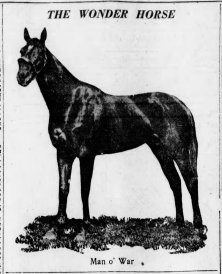
Happy Birthday, Man o’ War!

The_Brooklyn_Daily_Eagle_Thu__Aug_19__1920_Last year, I wrote a blog post (or two) in celebration of the 100th birthday of Sir Barton, the namesake of this particular website and the project I’ve spent most of the last four years writing. I live daily with Sir Barton and his connections; I’ve likely done more research on that horse, his owners, his trainer, his breeder, and others than anyone else ever has. Wherever Sir Barton went in his life, I follow in whatever way I can given the time elapsed between us. Inevitably, though, our journey intertwines with another chestnut colt, so ubiquitous in reputation that even people who may not know a thing about thoroughbred racing have heard of this horse.

Man o’ War.

Continue reading “Happy Birthday, Man o’ War!”

His Name Was Johnny

He was born John Patrick Loftus in Chicago, Illinois, the son of parents who had immigrated to the United States from Ireland. His father was an engineer; his mother birthed five sons: John, Martin, David, Frank, and Robert. Nothing in his background made horses a clear choice for young Johnny, but, nevertheless, he gravitated toward the racing life and made it his own.

Determination

When Johnny came of age, he was attracted to horses just as the racetracks around him closed, felled by the movement against gambling in the United States. Unscrupulous gamblers and the resultant scandals led to a wave of anti-gambling legislation in the United States. By the time young Johnny Loftus rode in his first race in 1909, the racing world within the vast expanse of American soil was shrinking down to just Kentucky and Maryland, with limited racing in far-flung corners like Jacksonville, Florida, where young Mr. Loftus rode his first race. He finished last.

Not an auspicious start to his career, but the young Loftus was determined to make a go of it. He loved horses, inhaled them even, content to sleep in their stalls and learn everything he could about them. Horses responded to him; he learned to become a master of pace, knowing how fast the horses around him were going and judging when to move his own mount in response. The skills he acquired in his years of traveling from place to place in search of mounts netted him wins in prestigious races like the Kentucky Derby, the Preakness Stakes, the Travers Stakes, and more. He rode the big name horses of the day: Exterminator, Regret, War Cloud, and more.

His biggest problem wasn’t getting the mounts, though; it was his physique. Loftus teetered on the brink of unemployment with every pound. His powerful legs might have helped him balance on the brief width of leather beneath him, but those muscles were also weight that he couldn’t shed. Johnny tried to ride at 110 pounds or less; often, he couldn’t manage to get below 112. A brief stint in Europe and the heavier weights horses carried there gave him some respite from the struggle, but, when he returned to the United States, the fight was on again. He could never escape the ravages of weight, but it wouldn’t stop his ascendency either. Johnny Loftus was one of the elite riders of his day, and, as a master of pace; his services would be needed for one Commander JKL Ross to win the 1919 Kentucky Derby and his bet with Arnold Rothstein.

Elite

The 1919 Kentucky Derby showed just how tough a fight it was for Loftus to maintain his weight. Sir Barton was assigned 110 pounds, the beneficiary of a twelve-pound break in weight because of his maiden status. His jockey Johnny had a body that rebelled against such light imposts; Sir Barton carried 112.5 pounds because Loftus’s physique, already haggard and sunken from the battles with weight, refused to shed the difference. The extra weight meant little to Commander Ross; Loftus was still one of the best jockeys in the country. He piloted Sir Barton exactly as planned, sending the speedy colt to the front with unexpected results: rather than burning off the speed horses and giving way to his stablemate Billy Kelly, Sir Barton won a wire-to-wire Kentucky Derby in the slop. The Derby winner’s circle photo shows Loftus looking lean and hungry, unable to crack a smile despite the fact that he had just won his second Kentucky Derby. That struggle with weight might mean that Loftus would ride a pound or so overweight, but his skills and record were such that it never seemed to matter to his employers. Johnny had more than his fair share of winners, with 580 winners from 2,449 mounts in his ten-year career.

In his career, Loftus won most of the major American stakes races, including the classics and, of course, the first Triple Crown. He rode Man O’War, Sir Barton, War Cloud, Regret, and many more top horses of that era. The first part of the twentieth century was a time when jockeys had no union and operated with contracts that could be bought and sold like the horses they rode, but Loftus was among the elite, riding for the top owners of the day, including A.K. Macomber, Commander JKL Ross, H.P. Whitney, and Samuel Riddle. For all of the laurels he collected, though, he has the misfortune of one black mark on his record: the 1919 Sanford Memorial Stakes.

Controversy

One of the first skills that jockeys in this era had to learn was how to balance the plethora of sensory inputs that were the starting barrier for any race. Long before the starting gate became a reality, horses stood in front of a stretched white fabric webbing before them which marked the starting line. On a stand on the other side of the rail was the starter, a man whose goal was to get all of the horses standing still and facing forward in line at the same time and then releasing them. Assistant starters, usually strapping men with horse whips, stood behind them, helping to get anyone unruly into line. Jockeys needed to have their own mounts in position while also watching for the starter to pull the lever and spring the barrier to start the race and do all of this with any number of other horses and jockeys trying to do the same thing. Kicks and shouts and false starts were all trials to be borne for the chance at the perfect start. Loftus mastered this skill as did many of the era’s greatest jockeys, all angling for the flying start that would catch their mounts already in stride as the barrier gave way to the action.

August 13, 1919 saw Saratoga without their usual starter, Mars Cassidy. Loftus was well aware of Cassidy’s tells, but was not at all familiar with his replacement Charles Pettingill. Pettingill, who had once been a starter before becoming a judge, was known for the seeming inability to do his job; a number of the races on the Saratoga card that day had terrible starts, with Pettingill unable to keep things tidy and orderly. Then came the Sanford Memorial Stakes.

Laden with 130 pounds, Man O’War was one of the high weights in the race, Golden Broom the other, also with 130 pounds. Loftus’s instructions were to let Golden Broom set the pace and then to move when he tired, rather than running on the front. The race was only six furlongs with every other horse massive underdogs next to the strapping Big Red. All Johnny had to do was avoid trouble and surely this start would end as all of the others would, with Red coming home first. Pettingill’s inability to get the horses at the start under control meant that Loftus, trying to get Man O’War back into position for a fresh start, wasn’t ready for the lever’s fall. The field got a jump on him and the greatest horse of the 20th century was nearly left at the post.

Doing his best to follow instructions, Johnny kept his mount behind the front runners, but soon realized that he was boxed in. Upset kept Golden Broom close to the rail, preventing him from squeezing through when the latter might bear out on the turn. Next to him was Donnaconna, just back on his flank. If he took Man O’War to the outside, going around all of this horseflesh, he would expend quite a bit of energy, that 130 pounds telling on any mortal body. If they stayed where they were, they would have to wait for an opportunity or create it. Loftus tried to create it, shouting for room to come through. Neither Golden Broom nor Upset gave way. The box was closing quickly as the ground between them and the finish line grew smaller and smaller.

Finally, Golden Broom gave way, the 130-pound impost too much. He fell back, leaving only one horse in front, and finally Loftus was able to swing Big Red to the outside. With only a furlong left, Loftus unleashed Man O’War, urging him to make up ground. Willie Knapp, Upset’s jockey, did the same on his mount and, though the gap between the two was starting to close, the bare furlong turned in mere yards and then only feet for Man O’War to close the gap and then eclipse Upset. But Upset carried only 115 pounds to Man O’War’s 130 pounds, enough to make a difference. The crazy start plus the rough trip meant that despite every inch of the twenty-eight-foot stride that Man O’War possessed was not enough to catch the elusive Upset. They crossed the finish line, with the aptly named Upset a bare half-length in front. In the next couple of strides, Man O’War had caught the upstart, but it was too little too late.

It would be Man O’War’s only loss. It would contribute to Loftus’s undoing.

Legacy

Despite going on to win three more starts on Man O’War that year, Johnny’s legacy became forever tied to the misfortunes that resulted in Big Red’s only loss. He mysteriously lost his jockey’s license the following year and was never able to regain it; he applied for a trainer’s license, though, and was granted that immediately. He stayed in the game as long as he could, training stakes winners for prominent owners, but, when he had a streak of bad luck, he gave up the racing game for something far calmer and less risky: carpentry. He died in 1976, far away from the bugle’s call and the tiny square of leather that had been his office for so long.

In the end, John Patrick Loftus was remembered less for the classics he won and the Triple Crown he helped to pioneer and more for the bad start and even worse racing luck that plagued Man O’War on that fateful day, the one black mark on Big Red’s career that haunted the jockey, not the horse, for years to come.

His name was Johnny, an Irish boy who rode horses and became one of the era’s best and brightest jockeys. He was one of the First, the right pilot for the right horse at the moment when history was made.

Many great & glorious thanks to Dorothy Ours & her book on Man O’War for giving me inspiration as well as serving as a wonderful source on Johnny Loftus & many other topics.

Head to Head

It’s not a match race, really. When a race has twelve horses slated to start, each paying $1,000,000 for the privilege of running, the Pegasus World Cup Invitational at Gulfstream Park is a true horse race. Twelve starters, many possible outcomes.

Right?

The coverage of the Pegasus, part of a slate of seven stakes races on Saturday, January 28th, pays lip service to the other ten starters, but really it all seems to come down to two horses: Arrogate and California Chrome. Arrogate, the four-year-old youngster, recently voted the world’s best racehorse by Longines, conqueror of the last year’s Travers Stakes and Breeder’s Cup Classic. California Chrome, six years old, on the verge of retirement and stud life, twice Horse of the Year, conquered by the upstart Arrogate both in the Classic and in the voting for world’s best racehorse.

The gate might hold twelve, but the world only sees two. Only two names matter.


Arrogate vs. California Chrome. Speedy wonder with only one loss in his racing career versus the veteran who nearly won a Triple Crown and beat all comers in 2016 except this newly minted rival. With one voted the best in the world, barely edging out the other, the question of supremacy becomes paramount.

Where have we seen this before?

Continue reading “Head to Head”

Making and Breaking Reputations


On October 12, 1920, about 3.37 pm, two horses stood at the barrier on Kenilworth Park’s dirt oval. The largest crowd ever to grace the stands watched as the two took to the track, one clad in Ross orange and black and the other in the yellow and black of Samuel Riddle, each known as the best of his class. As they lined up by the starter, one towering over the other, their riders took their positions, gripping the leather reins and waiting for this particular job to begin.

The match race itself had come together rather quickly, a response to the drumbeat of desire that threatened to drown out everything else in thoroughbred racing that fall. Man O’War had conquered all comers to that point, save for a slight blip on the map named Upset, but his owner’s caution had left one question still to be answered: how would Big Red fare amongst older horses? When Willis Sharpe Kilmer dropped his Exterminator out of the mix, Sir Barton became the symbol of the best that the older class had to offer: record setter under heavy weights, Triple Crown winner, the star of the Ross Stable. For the champion, though, the one who had done what Man O’War hadn’t, 1920 had been a hard campaign, with eight starts, three in August alone, after thirteen in 1919. Sure, Man O’War had had ten starts in 1920, but he didn’t have the shelly hooves that plagued Sir Barton. The track at Kenilworth was hard and fast, thanks to Abe Orpen’s hope for a speed duel. For Sir Barton, the solid surface and the residual soreness of a long campaign brought on lingering questions about soundness, but no one in the Ross camp was going to give their hand away. Kenilworth, though, had taken on a dour air as a result. As J.K.M. Ross laments in Boots and Saddles, this was “a battleground for greatness and a breeding ground for disappointment and distortion” (207).

With his obvious advantages in height and muscle, it was clear how tremendous Man O’War was next to Sir Barton. While the Triple Crown winner was not the largest horse, he clearly showed why he had been so good on the track versus so many of the era’s best horses. Standing there at the barrier, though, Sir Barton looked like a common plater next to Man O’War. The race was nearly a foregone conclusion, but Ross’s sense of sportsmanship wouldn’t allow him to withdraw from the contest. In the end, Man O’War’s conquering of his competition only intensified the ascendency of his star. For Sir Barton, though, it might have been the contributing factor to his slow fade into near obscurity.

Ninety-six years ago today, the Kenilworth Gold Cup was the match race that turned out to be no match at all. For Man O’War, the race resulted drinking champagne from the race’s gold trophy and retiring to stud to make an indelible and lasting mark on the pedigree of all thoroughbreds racing today. For Sir Barton, it was the end. He ran two more times, but his soundness and heart weren’t up to the task. He went quietly to stud and then, because of death and circumstance, to the Wild West, resting for all time in rural Wyoming.

But he left his mark loudly even if he went off quietly into the night. It’s in the walls of noise at Churchill Downs and Pimlico and Belmont in the spring. It’s in the vaunted places of horses like Citation, Secretariat, Affirmed, and now American Pharoah in the pantheon of thoroughbred racing. He may not have been a behemoth on the track, but his achievement on those spring days in 1919 has become the yardstick by which we measure all horses to this day.

Not even Big Red wears his crown.

Greatness Knows No Weight

In the Triple Crown races, colts and geldings carry 126 pounds and fillies carry 121 pounds. The idea is that a male horse holds a physical advantage over fillies (though I know fillies and mares throughout history that might challenge that idea) so the difference in weights gives each horse an equal chance at the same goal. So goes the wisdom behind assigning weights in a handicap: horses with good records and more talent receive higher weights than others who may not have shown such. With that in mind, let’s look at Sir Barton’s start in the 1919 Maryland Handicap.

By early October, racing in Maryland had shifted from Havre de Grace to Laurel for its fall meet. The question of who owned the three-year-old crown still lingered in the air as Purchase had wowed in his other starts in 1919 while Sir Barton had won those spring classics, but had had a series of mixed performance since then. The scuttlebutt had the two meeting at some point that autumn to decide the thing outright, but, in the meantime, Ross and company shifted their focus to Laurel’s slate of handicaps, including the Maryland Handicap.

Though the race had six starters, unlike his previous start in the Havre de Grace Handicap, Sir Barton’s competition was not nearly as stellar. No Cudgel, no Exterminator, and no Purchase; instead, the other starters were all colts that he gave anywhere from fifteen to twenty-seven pounds to, enough weight that these lightweights had a fighting chance, in theory.

Truly, they had none. Rather than engage in a speed battle on the front end, jockey Johnny Loftus hung at the back of the pack, waiting for the front-runners to burn themselves out before moving for the lead. As the field went around the last turn, Thunderclap surged wide, taking Sir Barton with him. The Triple Crown winner recovered and started picking off horses one-by-one until he only had Mad Hatter in front of him in the stretch. By the time the field hit the wire, Sir Barton had pulled ahead of Mad Hatter by two lengths, finishing in a time just two-fifths off the record for the mile and a quarter.

The race was called one of Sir Barton’s best performances to date, an exciting end to another rich race for the Ross Stable. Finally, the champion earned a break and didn’t start again until November.

Uneven Performances

Eleven days after his win in the Potomac Handicap, Sir Barton was back on the track at Havre de Grace, this time for the Record Purse. This first edition of the race was a one-mile allowance dash, a chance for the champion to carry lighter weight, 110 pounds rather than the 132 he carried in the Potomac. As he was to start three days later in the Havre de Grace Handicap, no doubt trainer H.G. Bedwell intended the Record Purse to be a tune-up for that next start, but it was Sir Barton’s eighth start in 1919 and perhaps the wear was starting to show.

Starting from the three post, Sir Barton jumped out just behind Midnight Sun at the start, sitting just behind him by the quarter pole and a head in front of The Porter. As the field reached the half-mile pole, though, The Porter passed both Sir Barton and Midnight Sun to take the lead and pulled away, winning by five lengths. As the Daily Racing Form put it, Sir Barton was ‘hard ridden throughout, but could never overtake the winner” (9/25/1919).

His next start in the Havre de Grace Handicap on September 27th wasn’t much better. Sir Barton jumped out to the lead at the start, while his stablemate Cudgel and the legendary Exterminator hung toward the back of the pack. By the stretch, though, the Triple Crown winner began to tire and Cudgel and Exterminator passed him, with his stablemate flashing under the wire as the winner. It took a new track record, 1.50 for the mile and an eighth, to beat him, but, nevertheless, the champion had been beaten again.

Sir Barton wouldn’t get much of a layoff as racing in Maryland shifted from Havre de Grace to Laurel, with his next start coming one week later, in the Maryland Handicap at Laurel.

Racing (and Retiring) a Classic Winner

Yesterday, Winstar Farms announced that 2016 Preakness Stakes winner Exaggerator (Curlin-Dawn Raid, by Vindication) was retiring from active racing to stand at Winstar. The colt retires with six wins in fifteen starts, including the Santa Anita Derby and the Haskell Invitational, and a number of finishes in the money, including finishing second in the 2016 Kentucky Derby. He joins Belmont Stakes winner Creator (Tapit-Morea, by Privately Held), who was sold to breeding interests in Japan and retired from racing to stand there, much like Sunday Silence and I’ll Have Another.

Today, classic winners like Exaggerator, Creator, and others who retire at three years old go that route because their genetics prove to be more valuable long term than their prowess on the track might. For Sir Barton, though, in 1919, the expectations were a bit different. Since the Triple Crown as we know it did not exist yet, though Sir Barton had conquered it just a few weeks before, his stock at stud wasn’t yet proven. In the Golden Age of racing, this early part of the 20th century, a horse made his reputation through speed and weight, i.e., handicaps. Ross and company turned their attention to running Sir Barton and his stablemate Billy Kelly in the day’s most famous races, handicaps like the Potomac Handicap at Havre de Grace.

The Potomac’s field was small: only five horses, three of which were from Ross’s own stable. Sir Barton was assigned 132 pounds, giving weight to them all of his competitors — even Billy Kelly, his accomplished stablemate — anywhere from seven to thirty-two pounds. This start was only two days after his previous effort in the Hip Hip Hooray Purse, a timeline that is almost unheard of today.

None of it mattered. He started from the outside post and jumped out to a flying start, taking the lead immediately. The others never threatened him, jockeying for position behind him, but still a length and more back of Sir Barton. The Triple Crown winner took home $6,900 for his efforts, adding to the rich purses he had already won in 1919.

The Potomac would not be Sir Barton’s last start for 1919; he had six more to go in his three-year-old season. Toward the end of the year, Commander J.K.L. Ross contemplated retiring his big-money horse, the unexpected star of his stable, but Sir Barton would go on to run one more season before retiring to stud. For horses like Exaggerator and Creator today, though, we bid them both ‘Adieu’ before they even see the end of their three-year-old season. Thanks to Sir Barton and the tradition of the Triple Crown that started with his win in 1919, those two colts and their status as classic winners means that the potential inherent in their genetics is now far more valuable than the money they would bring home on the track.


Coming Back After a Triple Crown

The term ‘Triple Crown’ was coined in the decade after Sir Barton’s springtime domination of the classics, which, at the time, had yet to solidify their reputation as such. Though War Cloud completed the triple first, showing that making the trip from Louisville to Baltimore to New York was worth the trouble, the money that Sir Barton amassed in purses in his pursuit of the first Triple Crown is really what set the stage for the classics and the Triple Crown to become the gold standard for thoroughbreds. The chestnut son of Star Shoot* completed the triple in only 32 days — throwing in the Withers in between — a schedule that no trainer today would dream of following. By the time he got to the one-mile Dwyer in early July, Sir Barton was sore and tired and his performance in that race showed it. He earned a much-deserved long layoff, until September 11th, 1919, when he ran in the Hip Hip Hooray Purse.


When American Pharoah came back from his Triple Crown triumph in 2015, his owners chose the Haskell Invitational, another mile-and-a-quarter race, for his return after eight weeks off. In all honesty, American Pharoah could have retired the moment he crossed the finish line at Belmont and no one would have batted an eye, such is the rarity of the accomplishment. AP had two more starts after the Haskell in 2015, the Travers Stakes and then Breeders Cup Classic, where he completed the first-ever Grand Slam. After he walked out of the winner’s circle at Keeneland, American Pharoah took his place at Coolmore Ashford Stud and hasn’t been under saddle since. For Sir Barton, though, it was a different time, where the Triple Crown wasn’t a thing yet and horses ran well into their fourth and fifth years and even beyond. He would run eight more times after the Dwyer in 1919, the first of those being the Hip Hip Hooray purse.

His performance showed that he needed a race to round him back into shape. Sir Barton took the lead at the race’s start, but faded by the end of the six-furlong dash, holding on to finish second behind his stablemate Billy Kelly. Both of them gave weight to their competition, 15 to 18 pounds, and both outlasted the others, but the eight-week layoff showed in Sir Barton’s performance. Two days later, though, he would be back on the track for the Potomac Handicap, also at Havre de Grace.