
Two years ago, American Pharaoh came into the Travers Stakes at Saratoga on an eight-race win streak, including the first Triple Crown in thirty-seven years. He had made his first post-Triple Crown start in the Haskell Invitational, where he had sailed to a two-and-a-quarter length win, showing that same easy running style familiar to race fans. He was the 1-5 favorite for the Travers and, despite shipping in from California at nearly the last minute, the victory seemed well in hand.
That is, until that last quarter of a mile, when American Pharoah’s dominance gave way to the stalking trip of Keen Ice, who managed to pass the Triple Crown winner as the field flew toward the wire. For American Pharoah, it was his first loss since his two-year-old season. For race fans, it was a clear disappointment that made even owner Ahmed Zayat ponder retirement rather than let his horse risk another loss in the Breeder’s Cup Classic, their next intended target. The Graveyard of Champions had claimed another victim.
American Pharaoh, of course, went on to win the Classic, completing the Grand Slam. He was voted the best three-year-old of 2015 and the Horse of the Year. That one loss in the Travers, which came as a result of the Triple Crown winner trying to overcome the pressure of a speedy Frosted, never cast doubt on whether or not the son of Pioneerof the Nile was the best horse in America that year. It would be unimaginable to think that AP wasn’t the best of his age and the best of all ages that year, right? Surely, winning the Triple Crown at least would net a horse those sorts of honors?
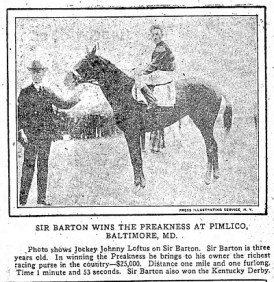 Nearly a hundred years ago, on July 10th, 1919, as Sir Barton returned to the track after his four-win streak that included our first Triple Crown, the three-year-old champion honors seemed to be his, no question. The win streak in itself was amazing; the way he did it, dominating each field in different ways, should have sealed it for him. Nearly a month after his romp in the Belmont Stakes, Commander Ross and H.G. Bedwell decided the Triple Crown winner would start in the Dwyer Stakes, a mile-and-an-eighth race named for the Dwyer Brothers, the New York brothers who owned a dominant racing stable in the late 19th century. Only two other horses met the Triple Crown winner at the barrier: Crystal Ford, a fair racer that was getting an eighteen-pound break from Sir Barton; and Purchase, who had missed the spring classics with an injury but had reeled off a series of wins in June. Purchase, despite his recent record, also got a weight break from Sir Barton, carrying fewer nine pounds at 118 pounds. Sir Barton’s 127 pounds was not a new impost for him and he had previously given weight to other horses and still dominated. The same level of expectation that followed American Pharoah into the Travers followed Sir Barton out onto the Aqueduct oval for the Dwyer.
Sir Barton and his two competitors trotted out toward the barrier, lithe feet dancing through the sloppy dirt beneath them. Johnny Loftus had his usual seat on Sir Barton, the Dwyer his first race of the day. Willie Knapp, the jockey destined to beat Loftus on another legendary horse in August, had the mount on Purchase. Purchase stood on the rail in the first post, Sir Barton on the outside and Crystal Ford in between them. Knapp’s position on the rail would have clued him into the condition of the track there. He would have seen the way that the intermittent rain drained off the Aqueduct track, making the going at the rail deeper. It was that soft going that assured Commander Ross that starting Sir Barton on this particular day was a good idea.
He was wrong.
The Triple Crown winner had bruised himself in a workout the week before the Dwyer, forcing Bedwell to lay off training for a few days while he gave the colt time to heal. The morning of the Dwyer, Sir Barton appeared recovered from his mishap and Ross opted to send his ascendant colt to the post with a fresher and injury-free Purchase. At the start, the Triple Crown winner took his usual position as front-runner, with Crystal Ford and Purchase a couple of lengths behind him. As the field rounded that last turn, Knapp took Purchase behind Crystal Ford and then went around that colt, setting his sights on Sir Barton, still running on the front. Loftus, sensing that Knapp was making a run at them, urged his mount on, but Purchase and Knapp gained ground and then passed them in that final furlong. As he flashed under the wire, Purchase had beaten the Triple Crown winner by three lengths, stunning the Aqueduct crowd. Commander Ross lamented the loss, seeing now that the colt still wasn’t back to his previous form.
Ross’s go-fever cost Sir Barton the stranglehold he had had on the three-year-old championship. Rather than enjoying a rest from his record-breaking spring campaign, the Triple Crown winner and his connections endured a summer of doubt, watching Purchase continue to turn in impressive performances on the track while Sir Barton stood idle in recovery. By the time Sir Barton returned to the track in the fall, Purchase was on the shelf himself after an injury had sidelined the upstart challenger before the two could meet again. At 1919’s end, Sir Barton’s fall campaign seemed to cinch the three-year-old championship, but the doubts about who was the best of the year lingered in 1920.
The rematch so many had been spoiling for never happened. Purchase returned to racing in 1921; Sir Barton retired that same year, standing stud at Audley Farm in Virginia after Commander Ross sold him to the Jones brothers. Sir Barton was recognized as the first Triple Crown winner, the three-year-old champion, and Horse of the Year many years later. The Dwyer was not his only loss for the year, but, in 1919, it was enough to plant a seed of doubt in the minds of fans and writers and inspire the same endless debates that we all engage in with our own contemporary favorites.
 Journeys start with a step. Sometimes, you don’t realize you’re on them until a moment lights up your life, illuminating the scene so you finally can see it all clearly. I didn’t know I was on this journey until I got an email that showed me this path. That was four years ago today. Happy Birthday to The Sir Barton Project!
 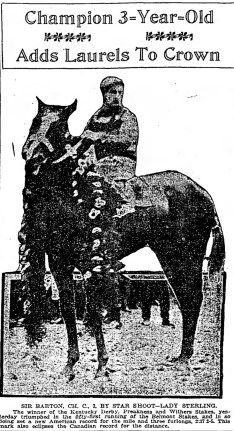 From maiden to monarch in a month, Sir Barton arrived at the barrier for the Belmont Stakes in a roundabout way. Speculation held that he would ship to Latonia for the Latonia Derby, but factors outside the control of both owner J.K.L. Ross and trainer H.G. Bedwell kept the Derby and Preakness winner in Gotham. So, on the last day of Belmont’s meet, the chestnut son of Star Shoot and Lady Sterling strode out onto the track with only two other challengers as the morning-line favorite to make history, unbeknownst to any of the 25,000 people present.
 The crowd thronged Sir Barton and his connections in the paddock, craning to get a glimpse at the horse that had dominated in Louisville and Baltimore, winning an unprecedented double that had already made an impression. The colt was calm throughout, with only the call to the post sending him dancing with anticipation. At the barrier, he stood on the rail, Natural Bridge and Sweep On to his right, both earning their footnote in history as his only competition. When the barrier flew up, Sir Barton jumped into the lead, ready to run only to have his energy reined in by jockey Johnny Loftus. They sat a couple of lengths back of Natural Bridge for the better part of the race, Sweep On bringing up the rear. Entering the stretch, Loftus relented on the reins and Sir Barton took off, swallowing ground like a thirsty man in a desert as he caught up to and then passed Natural Bridge within a furlong. Once they were a couple of lengths in the clear, Loftus reined his mount in once more, Sir Barton still full of run but listening to the capable hands of the man who had been with him throughout this miracle run.
 He finished the mile and three-eighths in 2.17 2/5, a new American record. His performance made his supposedly high-class competition look like the commonest of platers as he beat them both with such ease that encomiums like ‘horse of the decade’ showered down on him from the throng of people present. In the winner’s circle, Ross shook hands with Loftus and playfully patted Sir Barton, accepting
  As we look at the ever-evolving picture of the 149th Belmont Stakes, a look back at the 51st running, the first that resulted in the very thing that so many racing fans look forward to each year, shows how little has changed about the phenomenon of racing. On Saturday, these good three-year-olds will take The Test of the Champion and one will emerge victorious. While Always Dreaming and Cloud Computing might be absent, a win in the Belmont is still an achievement to brag about: Triple Crown Classic winner at a mile and a half. Whoever finishes first, in the end, can etch their name in history alongside Sir Barton as winner of the Belmont Stakes.
 With this year’s edition of the Kentucky Derby coming up fast, let’s look at something that a horse rarely can be entering Derby week: a maiden. With the Derby now requiring a certain number of points in order to make it into the gate, a horse will need to finish in the money in more than one race or finish second in the right races to join the cavalry charge of horses in Louisville. Before the points system became reality, a horse could come into the Derby as a real maiden; nine have done it since 1937. Their chances of winning, though, might not be as good since they may not have the experience or the talent to be the one in front at the wire at Churchill Downs.
 In the last part of the 19th century, African-American jockey Isaac Burns Murphy won three Derbies (1884, 1890, 1891), his first on a firebrand chestnut named Buchanan.
 Sir Barton made his last start of 1918 in the Futurity at Belmont in September; he was due to make additional starts in his two-year-old season before an illness put him out of commission for the remainder of the year. Trainer H.G. Bedwell declined to start the colt in any races in the first part of 1919, though stablemate and fellow Kentucky Derby starter Billy Kelly did have three starts prior to Derby Day. Sir Barton prepared instead through a series of workouts with other horses in the Ross Stable, demonstrating just how good the three-year-old son of Star Shoot* was.
 Broker’s Tip’s jockey Don Meade sent his mount to the inside of frontrunner Head Play, ridden by Herb Fisher. Incensed that Meade had snuck up on him, Fisher tried to push Broker’s Tip into the rail, to which Meade responded by pushing back and attempting to pull Head Play’s saddlecloth. Fisher took a couple of swings at Meade with his whip and suddenly the two jockeys were exchanging blows as their mounts dueled down the stretch. At the wire, Broker’s Tip managed to get his nose in front, or at least that’s how the judges saw it. Fisher lodged an infraction claim against Meade, which went nowhere, and then the two continued their fight in the jock’s room. (The two made up and even came together years later to talk about that Derby.)
 Both jockeys received suspensions for their rough riding in the Derby. Broker’s Tip got a trophy, the purse, and his lone win of his career, but that photo of Meade and Fisher fighting down the stretch stands more iconic than the horses involved.
 If you’re going to be in Baltimore at Pimlico on May 20th, guess what? We will be there as well! That’s right: The Sir Barton Project (i.e., myself and my amazing husband) will be there to experience the joy and pageantry of Preakness weekend at Pimlico. I’ll be around for both Black-Eyed Susan and Preakness Days, another tick off my personal bucket list.
 Last year, I wrote
  It all started with a book. This book, to be precise.
 The Sir Barton Project