1918 Belmont Futurity

With five starts behind him, Sir Barton’s shiny pedigree with its English Triple Crown winners and juvenile superstar half-brother was starting to look a bit tarnished. All of the flash and form he showed to clockers in the morning had yet to make an appearance in the afternoon when it truly mattered. John E. Madden sold the colt to his friend J.K.L. Ross with the promise of pedigree and performance, but with 1918 on its way out, Sir Barton needed to make good on those promises.

He had been in the barn of H.G. Bedwell for not quite a month, but the Hard Guy must have seen something starting to unlock in the Star Shoot* colt for they took advantage of Madden’s foresight to nominate the colt in the Belmont Futurity as a foal and entered him for the 1918 edition of the most prestigious juvenile race of that era. Sir Barton had fourteen other competitors on the sandy oval of Belmont that day, including Duboyne and Purchase, two other good juveniles who promised to make waves in 1919 as well. The fifteen went to the barrier at 3.46 pm on Saturday, September 14th, with Sir Barton in the thirteenth post, far on the outside, and a young Earl Sande on his back.

At the break, Sir Barton came out in sixth and then eased in behind the front runners, Duboyne, The Trump, and Pigeon Wing. At the half-mile pole, he was fourth; at the three-quarters, he was third. In the stretch, as Pigeon Wing began to fade, Sir Barton moved up into second, only a length and a half behind Duboyne, who had been on the lead for the whole race. Andy Shuttinger shook up Duboyne and the colt increased his lead to 2 1/2 lengths over Sir Barton at the finish, but, as J.K.M Ross writes in Boots and Saddles, Commander Ross “seemed more pleased with the result than I had ever seen him. […] Even on the following day, while lunching with Duboyne’s owner at the old Ritz-Carlton, my father was still smiling so broadly that anyone would have thought it was his horse and Mr. Clark’s that had won” (132).

Sir Barton’s first finish in the money portended even more when Earl Sande recounted his experience at the start of the Futurity. Had Sir Barton not been boxed in by the general tangle of a large field, he likely would have had a chance to move into a position that would have allowed him to catch and even pass Duboyne.

In October 1918, before Sir Barton could get another start in at two, a kick from another horse opened a cut on his stifle, which soon became infected. The resulting blood poisoning sent the colt’s temperature to a dangerous 105 degrees, but Bedwell, who had lived intimately with horses since he was a young man, nursed Sir Barton until he recovered. The illness put the son of Star Shoot* on the shelf for the rest of 1918, not to be seen again until Derby Day 1919.
A Writer’s Job

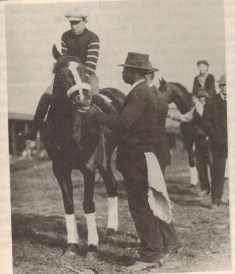
sbfrombook09142016I found this image in a book on the Triple Crown winners (10 at the time) published in 1978. I literally had never seen this photo before I got that book so I’m going a-hunting for it. The book credits the image as coming from UPI and I’ve already contacted them in an attempt to find it. It looks similar to this image so I’m thinking these are from the same day in October 1920, when Sir Barton was at Kenilworth for the match race with Man O’War.

This is part of the job of chronicling Sir Barton’s story. I’m determined for it to be complete and I’m endeavouring to track down leads for anything that might be a vital part of the story.

Thank you for joining me on this journey!


Sir Barton in the 1918 Hopeful Stakes

Yesterday, Saratoga’s last day of racing for 2016 featured the 112th running of the Hopeful Stakes, a seven-furlong race for two-year-olds. This year’s winner was Practice Joke, a colt who showed that breaking his maiden in his first start was no joke.


The Hopeful’s history is long and storied, its list of winners including many legendary horses, including Regret, Man O’War, Whirlaway, Native Dancer, Secretariat, and Affirmed. If you look up the 1918 running of the Hopeful, you’ll see that the winner was a horse named Eternal, who would go on to become one of the winter book favorites for the Kentucky Derby, along with Billy Kelly. Another starter in the 1918 version was a chestnut colt named Sir Barton.

Ten days or so earlier, Sir Barton had gone from the barn of his breeder John E. Madden to that of Commander John Kenneth Leveson Ross, his reported price tag to be around $10,000. The colt’s workouts had promised many good things, but his race performances had fallen well short of that promise. Now, in the Ross barn, his preparation was turned over to trainer Harvey Guy Bedwell, who figured out that the Star Shoot colt didn’t respond to workouts unless he had company. They entered Sir Barton in the Hopeful, hopeful that he would break his maiden and make good on all of his promises.

He would finish 16th out of 20 horses, rewarding his new owner with another lackluster performance. His pedigree held prestige, his workouts demonstrated speed, but Sir Barton wasn’t ready yet. When he was, though, this son of Star Shoot showed everyone what being the right horse in the right place at the right time could become.

Sir Barton Wins the Merchants & Citizens’ Handicap


Fresh off a victory in the Dominion Handicap, Sir Barton had made the trip from Fort Erie back to Saratoga, where he had won the Saratoga Handicap earlier in the month. His Dominion victory was a special one for owner J.K.L. Ross, who was deeply involved in growing racing in Canada now that the War was over. Sir Barton was the most accomplished horse in his stable and Ross was thrilled to be able to show him off in his native land. Now, though, it was back to business as the Triple Crown champion marched toward a date with the ascendant Man O’War.

The Merchants and Citizens’ Handicap was a 1 3/16 mile feature on the card for August 29, 1920. Sir Barton originally had four other competitors, including his stablemate, Boniface. By post time, though, the field was down to three: the champion, Gnome, and Jack Stuart. Earl Sande was back on Sir Barton, as he had been for much of 1920, and Frank Keogh was on Gnome. The purse was about $7,000, with $5,200 going to the winner.

As the three horse rolled toward the barrier for the start, rumors persisted that Sir Barton had not shipped well, reducing his backing in the betting somewhat. A lackluster warm-up before the race further solidified doubts about his condition. Couple that with the weight he was carrying (133 pounds) and the weight he was giving to his competition (18-24 pounds) and it was clear to see why Sir Barton wasn’t as sure of a bet as he might have been.

From the start, Sir Barton jumped out to the lead and never let it go. His fractions were fast: 23 2/5, 47 2/5, 1.12 3/5, 1.36 2/5. He led by a length for most of the race, with Jack Stuart behind and then Gnome. In the stretch, though, Keogh sent Gnome to challenge the champion and it took all of Earl Sande’s talent as a rider to keep Sir Barton’s head in front of Gnome’s. As they thundered down the stretch, as depicted in the photo above, the Triple Crown winner bobbed his nose just in front of Gnome’s, finally flashing under the wire to the roar of the Saratoga crowd. The photo finish system had not been invented yet and so close finishes came down to the judges, who ruled in favor of Sir Barton. The time? 1.55 3/5, a new American record.

With this race, Sir Barton set his second American record in a month and the calls for a match race with Man O’War grew in volume. Rumors of their meeting in the Saratoga Cup among other races would finally give way to a match race at Kenilworth within six weeks of this race, Sir Barton’s last win.

Why I’m Working on This Book in One Quote…

“Sir Barton, chestnut colt by Star Shoot – Lady Sterling, was the outstanding three-year-old of 1919 and even such good horses as Eternal, Dunboyne, and Sweep On were overshadowed in performance by the Ross crack. His name on the roll of Preakness winners is a credit to the stake even though his performances were doomed to fade in brilliance before the coming of a mightier champion in 1920.”

Daily Racing Form, 5/14/1922

The 1918 Sanford Memorial Stakes

On August 14th, 1918, Billy Kelly, a gelding recently purchased for the Ross Stables by trainer H.G. Bedwell, went to the barrier at Saratoga for the Sanford Memorial Stakes. With him at the barrier, in post seven, was Sir Barton, still part of the John E. Madden barn, though that would soon change. Billy Kelly stalked the leader, Lion D’Or, for the majority of the race and then overtook him in the stretch, pulling away to win by five lengths. Carrying 130 pounds and giving weight to the other seven starters, it was another emphatic win for Billy Kelly, Bedwell’s purported favorite.

As for Sir Barton, it was another performance that didn’t quite hint at what was to come. He finished seventh out of eight horses, barely beating Pastoral Swain by a neck. He didn’t even merit a mention in the Daily Racing Form’s form chart for the Sanford Memorial. It was Sir Barton’s fourth start as a two-year-old, but, in only a few days, John E. Madden, breeder and horse dealer extraordinaire, would sell the chestnut son of Star Shoot to J.K.L. Ross. The major players would finally all be in place.


(By the way, the 1919 version featured a future King of All the Things Man O’War and Upset. We all know how that one ended…)

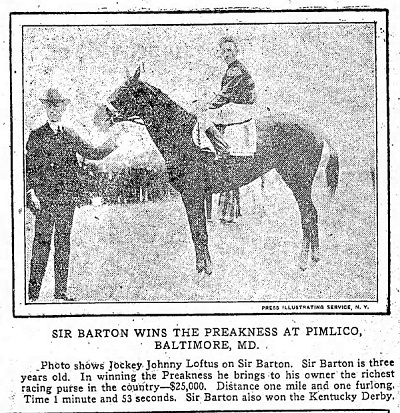
Sir Barton Wins the Preakness Stakes!

The_Washington_Times_Thu__May_15__1919_

When he crossed the finish line first in Louisville on May 10th, Sir Barton earned himself a trip to Baltimore and Pimlico for the Preakness on May 14th. It was a path that only four other horses had taken before him, but the $25,000 purse made the 600-mile trek worth it. With only four days separating the two races, it was a big question mark for H.G. Bedwell and J.K.L. Ross whether or not the chestnut colt could duplicate his Derby victory, but they seemed willing to try. Sir Barton was put on a train and shipped to Baltimore as soon as possible after his Derby victory. Stablemate Billy Kelly, who had finished second in the Derby, was not eligible for the Preakness because he was a gelding so the connections decided to send the good filly Milkmaid with Sir Barton instead.

Johnny Loftus was back on Sir Barton’s back for the Preakness and Earl Sande, the Ross Stable’s contract rider, had the mount on Milkmaid. The track was fast this time and Sir Barton carried the full 126 pounds, no longer running with the benefit of the maiden allowance. Supporters of horses like Eternal thought of Sir Barton’s performance in the Derby as a fluke, that the maiden allowance or the muddy track explained the whole thing. This was a one-off like other horses who just happened to run their best race that day and then never again. They were wrong, though: Sir Barton was no flash in the pan.

He proved it from the start of the Preakness. Sande and Milkmaid were there to help ensure that Sir Barton would get a good start since another starter, Vindex, tended to be fractious at the barrier. If Sir Barton looked to be compromised in any way, then Sande was to shake his mount up so that the starter wouldn’t be able to drop the barrier. This had to be done, though, without the judges catching him so Sande wouldn’t get in trouble. Finally, the field was still enough for the barrier to lift and the race to begin.

Sir Barton shot to the lead and, much like the Derby, never relinquished it. He was a length ahead of King Plaudit until the three-quarters mark when Eternal, who was supposed to get his revenge in this race and prove his backers right about his ability, made his move. In the stretch, Sir Barton pulled out to a six-length lead and then Loftus eased the son of Star Shoot, flashing under the wire four lengths ahead of Eternal. In winning the Preakness, he did something that no one else had done at that time, winning the Kentucky Derby and the Preakness. At this point, only one other horse had made the trek from Louisville to Baltimore to New York, that being War Cloud in 1918, and only three others had traveled from Louisville to Baltimore for both races. Never had anyone won both. The double was quite a feat at the time.

Of course, Sir Barton would go on to win the Belmont a little over three weeks later and become our first Triple Crown winner. Despite his stellar credentials on the track, Sir Barton was less successful in the breeding shed. Eternal, for all of his lack of success in what we now know as the classics, made his mark on racing by siring enough good horses that he appears in the pedigrees of some of the 2016 Kentucky Derby starters.

Ninety-seven years ago today, we were that much closer to the racing world being changed forever. One more race laid between Sir Barton and immortality. Two more lie between Nyquist and his own place in racing history.

The_Edwardsville_Intelligencer_Sat__Jul_5__1919_

Sir Barton Wins the Kentucky Derby!

The 1919 Kentucky Derby was supposed to be a battle between Billy Kelly and Eternal. Both colts had been the best of the juveniles the year before and both were highly regarded, so much so that notorious gambler Arnold Rothstein bet J.K.L. Ross, Billy Kelly’s owner, that Eternal would win. The bet was $50,000, a sum that would be closer to $700,000 in today’s money.

Ross had several three-year-olds in training, but his trainer H.G. Bedwell elected to bring Billy Kelly and Sir Barton, who hadn’t raced since his start in the Belmont Futurity the previous September, to Louisville for the big race. Billy Kelly had had a good spring, winning his last three races prior to arriving at Churchill Downs. Sir Barton, still a maiden, had shown quite a bit of speed in his workouts, but his long layoff, a result of his fight with blood poisoning the fall before, made him a question mark still. Bedwell saw Sir Barton’s speed as a potential tool for eliminating Eternal and making the way for Billy Kelly. Cal Shilling, a former jockey and now Bedwell’s assistant trainer, was advocating for Sir Barton, but Billy Kelly was Bedwell’s favorite. When the skies opened up over Louisville, Bedwell got antsy about starting the son of Star Shoot; he wasn’t sure how Sir Barton would handle the muddy track. But, at 5.10 pm on May 10, 1919, twelve horses went to the post, with Billy Kelly and Sir Barton coupled in the betting.

Sir Barton broke in front and no other horse got a nose in front of him throughout the mile and a quarter. This son of Star Shoot held off all comers, including his stablemate Billy Kelly, to win the Kentucky Derby in 2:09 4/5 on a track rated as heavy. He carried 112.5 pounds, his jockey Johnny Loftus unable to lose that last 2.5 pounds to get to 110 pounds, the weight maidens carried. The next day, Sir Barton went to Baltimore for the Preakness, set for May 14th, just four days after the Derby.

With his win in the Derby, Sir Barton set off on his path toward the first Triple Crown. Ross collected on his bet with Rothstein, a $50,000 check arriving soon after Billy Kelly beat Eternal while finishing second to his stablemate.

Happy Birthday, Sir Barton — Part Two

Today was Sir Barton’s 100th birthday. He is buried in Douglas, Wyoming, home of the Hylton family, his final owners, and, because of the distance between the two of us, I was unable to be in Douglas to lay flowers on his grave in honor of his birthday. Thankfully, Lori and her staff at The Boondocks Flowers and Gifts in Douglas helped me out by creating a bouquet of roses — the flower of the Kentucky Derby — and laid them on Sir Barton’s grave. They even sent me pictures!

Happy Birthday, SB! Thank you, Lori, for helping me on this important day!

Happy Birthday, Sir Barton!

One hundred years ago today, in a foaling barn on Hamburg Place in Lexington, Kentucky, Lady Sterling gave birth to one of only a handful of foals she was able to produce in her lifetime. His coat was chestnut and his face had a crooked blaze that flared to the right, covering the right side of his muzzle. His foal number was 187-16, 187 his dam’s number and 16 the year he was born.


Welcome, Harry Hale?

John E. Madden, the colt’s breeder, wanted to name Lady Sterling’s foal, a son of Star Shoot, then one of America’s leading sires, Harry Hale after his son’s commanding officer. Concerned about the appearance of brown-nosing, his son convinced Madden to name the foal Sir Barton, after Sir Andrew Barton, noted privateer and High Admiral of the kingdom of Scotland in the late 15th century. The colt was a half-brother to Sir Martin, Madden’s own champion who was standing stud at Hamburg Place as well. Much like his half-brother, Sir Barton’s pedigree held promise, with two English Triple Crown winners and other champions in his lineage.

From the get-go, Sir Barton stood out. A visitor to Hamburg Place asked about the yearlings currently there; the operation regularly turned out hundreds of thoroughbreds in a year. Frank Brosche, the farm’s colt breaker, brought out the chestnut colt and declared him “king of them all.” Madden took Sir Barton to the races at age two, but, as a late spring foal, it took him several races before he began to show any glimmer of the potential Brosche saw.

At the Races

John E. Madden’s philosophy was that it was better to sell than to hold on to his horses, no matter how dear to him they might be. He knew J.K.L. Ross was trying to build a championship stable and so Madden approached him about adding Sir Barton to his burgeoning string of racers. The Canadian purchased the colt in August 1918, for a reported $10,000 (though some newspapers had the purchase price as $20,000). At first, the colt didn’t do much for Ross; he didn’t like to work so trainer H.G. Bedwell had to stage races as workouts for Sir Barton, using other horses in the stable to round the colt into form. During one workout, he got too close to another horse, Foreground, and received a kick in the stifle for it. The wounds from that kick festered and Sir Barton nearly died of blood poisoning in the fall of 1918. Bedwell nursed him back to health himself, but it meant that Sir Barton went to Louisville for the 1919 Derby still a maiden.


Bedwell wanted Sir Barton in the Derby to set a fast pace and wear out the other favorites so that Billy Kelly would have a chance to score, but, if Sir Barton seemed to be able to win on his own merits, the trainer encouraged jockey Johnny Loftus to let him. The colt did, breaking his maiden in one of the racing world’s biggest events. Some dismissed the win as a fluke, with a maiden allowance of ten pounds possibly giving Sir Barton an advantage. The son of Star Shoot was no flash in the pan, though, as he proved four days later in Baltimore.

Sir Barton followed up his unexpected win in the Kentucky Derby with another win in the Preakness Stakes, a double that had never happened before, and then wins in the Withers Stakes and the Belmont Stakes, all coming within a month. He set the world on fire with his new form, named the top three-year-old of 1919 and then became a highly regarded older horse at age four. He might even be counted among one of the greats of his era had he not run up against the 20th century’s greatest thoroughbred, Man O’War, who was one year his junior. After a defeat at the hands of Man O’War in an October 1920 match race, Sir Barton ran three more times, losing each race, and then was retired the following year.

After the Glory

Ross then sold the champion to Audley Farm and the Jones brothers, who themselves had a fledgling racing and breeding operation. When his stud career failed to match the luster of his racing career, the Jones brothers turned Sir Barton over to the Remount Service, which supplied horses for the military. Sir Barton started out at Fort Royal in Virginia, then went to Nebraska, and finally ended up in Wyoming, at the ranch of Dr. Joseph Roy Hylton. There, Sir Barton spent his remaining years, showing little of the cantankerousness that he had had during his racing career. The champion died October 30, 1937 after a bout of colic. He was twenty-one years old. Hylton buried him on the family’s property in the Laramie Mountains.


Dr. Hylton passed away in 1946 and eventually the ranch changed hands. Concerned about Sir Barton’s grave being lost, Douglas, WY resident Gordon Turner worked along with the Douglas Chamber of Commerce to raise the funds to move Sir Barton’s remains from that near-anonymous grave to his current resting place in Washington Park.

Above All, the Legacy

For all of the things that this son of Star Shoot and Lady Sterling was – sore-footed grouch, lackluster stallion, or second fiddle to the greatest horse of an entire century – Sir Barton’s legacy of winning the Triple Crown, the first to claim all three and only the second horse ever to run in the three classics, has shaped thoroughbred racing as we know it today. As we celebrate American Pharoah’s feat in 2015, as we look forward to asking Can it can happen again? this year and every year, we can look toward Douglas, Wyoming and the final resting place of the first Triple Crown winner and contemplate his place in racing history.

Happy 100th Birthday, Sir Barton!